John Henry Sturman

FROM ROTHWELL TO CHINA

John Henry Sturman set sail for China on 10th October 1883 on the P&O steamer Khedive to begin work as a missionary in Chefoo, now Yantai, China when he died aged just 27.

Sturman was a late convert to the church. His diaries and letters written during his time in China, describe his early life in Rothwell, "...the Spirit strove hard with me, but I listened to the voice of the tempter, and bartered for the time being my soul for music. At sixteen I was persuaded by a young man, when on my way to the bowling alley, to go to special services then being held in the Wesleyan Chapel. I went, determined while there to make fun of the whole affair, and carried out my purpose so far as to cause the preacher to leave the pulpit and come up into the gallery where I was sitting, and in the pew behind he stood and prayed God to have mercy upon us and save us."

CONVERSION, CONGO & CHINA

Sturman writes that his conversion was sudden, and heavily influenced by an unnamed woman. It's not explicitly stated that this conversion happened in Rothwell, but given that he is commemorated in the church it is likely. He goes on to state that from the very first he had a distinct impression that God had designed him for missionary service.
Sturman attached himself to the Baptist Church in Carley Street, Leicester. He was, by all accounts well liked and he was encouraged to study at Hulme Cliff College. Here he made good use of the opportunities afforded him and it was here that his spirituality grew. Originally Sturman had contemplated going to the Congo, but due to circumstances which are not mentioned, but which Sturman clearly felt was of God's making, he did not take this route. Instead he made application to the China Inland Mission, and being accepted, set sail 10th October 1883, reaching Shanghai November 29th.
A celebratory tea was held in the school rooms at Rothwell on 27th September for approx 150 well-wishers where minister of the day Rev. Edwin Wilson presented Sturman with a framed testimonial and a purse containing 10 guineas.
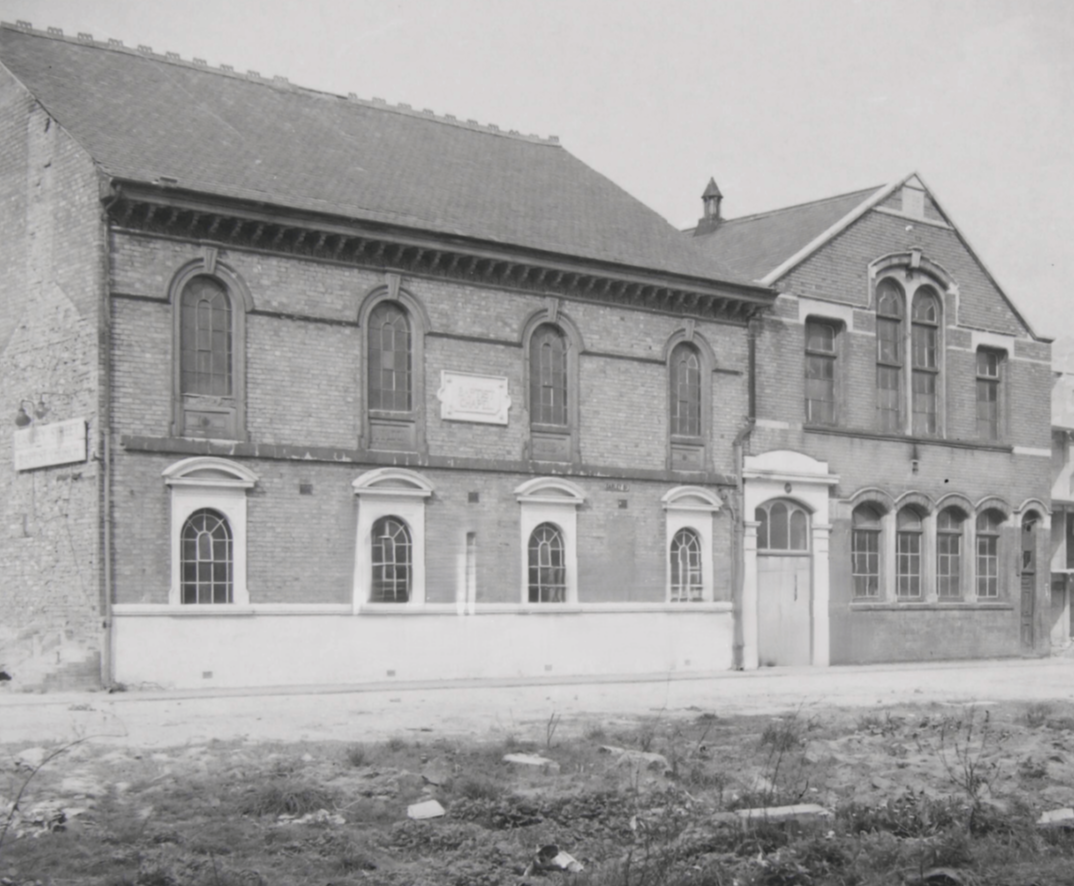
Carley Street Baptist Church, Leicester

YANG-CHAU to T'AI-YUEN

Sturman travelled through the opium rich regions of Yang-chau, Fan-cheng, Ning-hsia, and T'ai-yuen early in his mission where be spent a productive 13 months converting the locals to Christianity. It was at T'ai-yuen that his health deteriorated resulting in Sturman being struck down with typhus fever. He rallied and returned to work, but luck was not on his side as whilst on a journey in the region he was set upon by a gang of men and severely beaten. The beating and the exhausting labours connected with the opium refuge, didn't help him and he soon succumbed to a recurrence of fever. 

CHEFOO

He arrived at Chefoo in April 1885, where his health began to improve so that he was once more able to continue his missionary work. It was in 1886 that Sturman learned of the impending arrival in the province of someone to whom he was very close. It is not clear whether this was a prospective wife, or related to his religious devotion, but it wasn't long before the his health took a turn for the worse. Suffering from a bowel inflammation he was racked with excruciating pain for weeks. He was nursed throughout this time by Mrs Judd, but it was in vain and on the morning of December 8th 1887, he passed away.
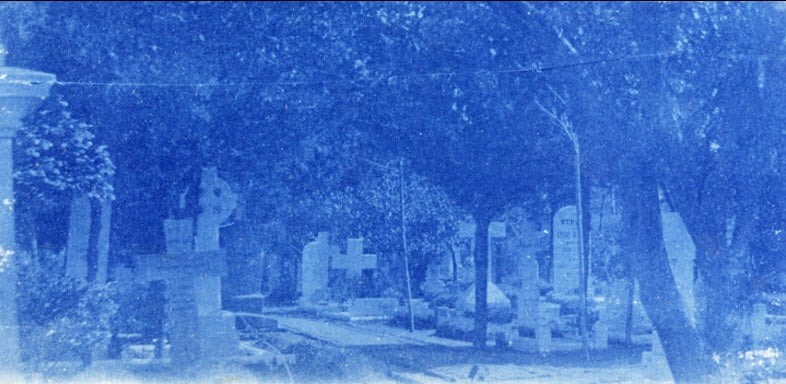
Mrs Judd, writes :—"At nine o'clock on Thursday morning, 8th Dec 8th, he passed away. For the last few hours he was quite unconscious, but up to that time he had constant pain, which was only relieved by morphia." During the last few days he knew that he was dying, and had made peace with the fact. Sturman was buried the following afternoon in the Chefoo Temple Hill cemetery.

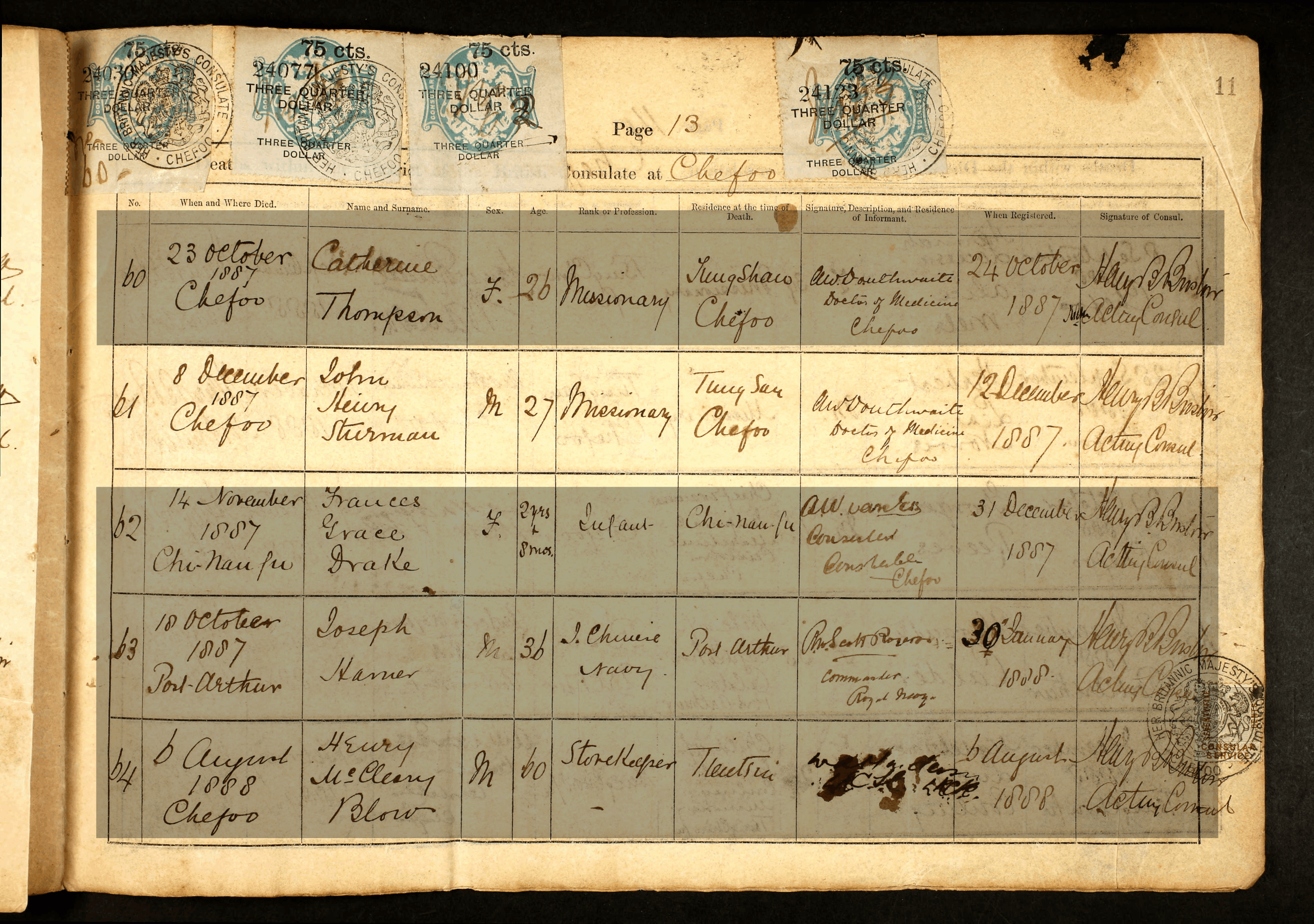
The above certification, obtained from The National Archives at Kew and originally from the collection of various Consulates in China: Registers of Births, Deaths and Marriages; Class: FO 681; Piece: 17, confirms the death of Sturman. He was sent to Chefoo (now Yantai), by the China Inland Mission which had been founded in England in 1865 by James Hudson Taylor. 
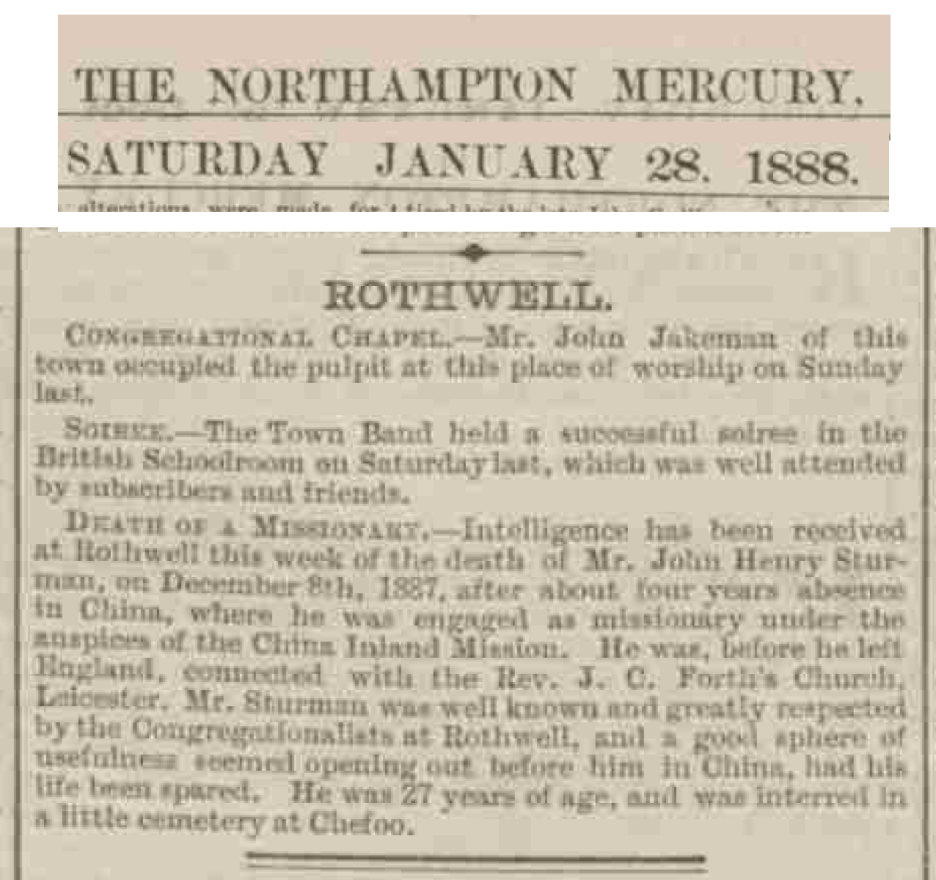
Reports of his death reached Rothwell the year after his death, as reported in the January 28th 1888 Northampton Mercury.

© Copyright 2026 All Rights Reserved